
Emergency water removal in Katy, TX
Standing water spreads fast on a slab-on-grade home. Here's what happens first and what actually stops it.
Get Help Now(281) 801-922224/7 emergency line. Free estimates from local pros.
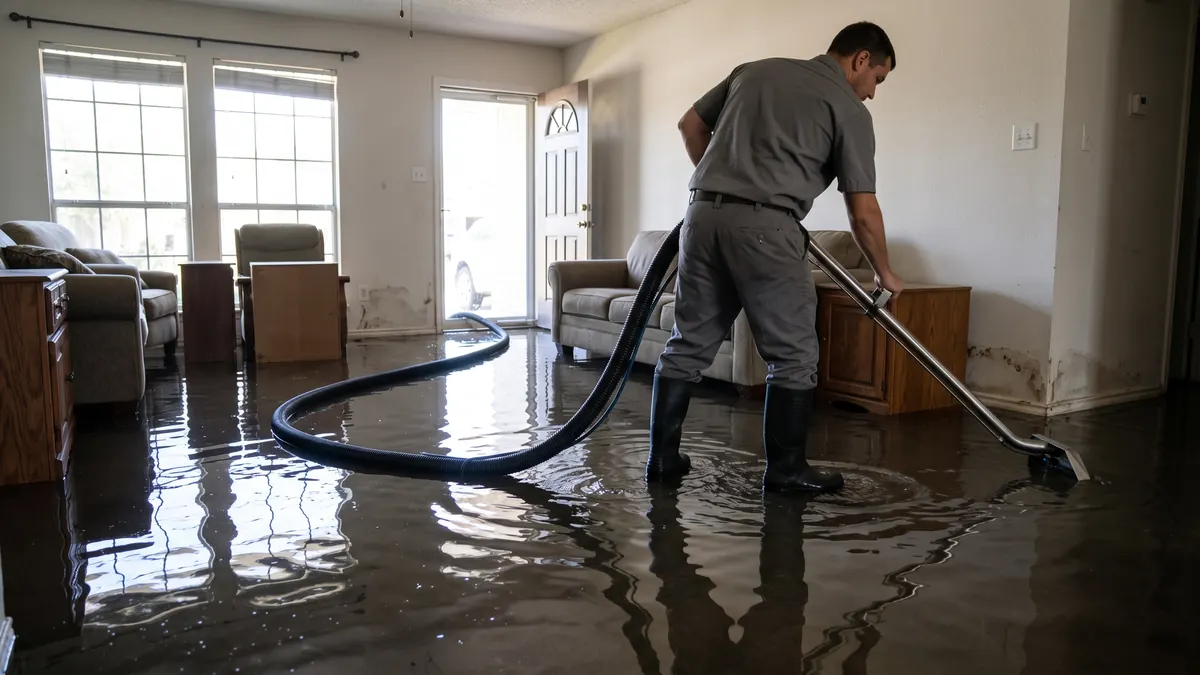
Emergency water removal means pulling standing water out of a house fast, before it soaks deeper into flooring, drywall, and framing. In a Katy home that usually means a truck-mounted extraction unit working the room within the first hour, not a shop-vac and a lot of hoping.
What standing water does to your home, hour by hour
Water doesn’t wait politely on top of the floor. The moment it’s down, it starts wicking sideways into baseboards, grout lines, and carpet pad. Give it thirty minutes and it’s climbing into drywall through the paper backing. Give it a couple of hours and it’s found its way under cabinets, behind baseboards, and into wall cavities you can’t see from the room.
Because most Katy homes sit on a concrete slab, water doesn’t stop at the wall it started against. It travels along expansion joints and slab seams and shows up in a room that never got wet on top. That’s the part a homeowner with towels and a fan usually misses: the water that already moved on. That’s true whether the house is an older place near Old Katy with decades of settled slab seams or a newer build out past Cane Island or Elyson, because the physics doesn’t care how new the drywall is.
The crews we send out bring equipment built for that reality. Extraction machines pull far more water, far faster, than any shop-vac, and moisture meters find water hiding inside walls and under flooring where you can’t see it.
What a water removal crew does first
A real visit follows a rough order. Extraction comes first, pulling out standing water so drying equipment has something to work with. Next comes moisture mapping, where a technician uses a meter to check walls, baseboards, and flooring in every direction from the source, not just the spot that looks wet. Only after that does the drying equipment go in: air movers to push moisture out of materials, dehumidifiers to pull it out of the air.
Some jobs also need specialty tools most homeowners have never heard of, like small injection systems that push warm, dry air directly into a wall cavity through a series of tiny holes, instead of tearing the wall open first. That approach saves drywall that would otherwise get cut out and replaced, which matters when you’re trying to keep repair costs down.
Skipping steps is how a wet room turns into a moldy one. Water damage repair picks up once the drying phase ends, when the question shifts from how to dry a space to what needs replacing.
Shut off water and power before anything else
If the water is still running from a burst pipe or supply line, get it stopped at the shutoff valve before you do anything else. If water is anywhere near outlets, switches, or a breaker panel, cut power to that area at the breaker, not the switch on the wall.
One local wrinkle: whether the City of Katy or one of the area’s many MUDs bills your water depends on your exact address. If you ever need a shutoff at the meter instead of inside the house, check your utility bill or the city’s MUD lookup tool first. Calling the wrong utility wastes time you don’t have.
What to move, and what to photograph first
Move what you can lift without hurting yourself: rugs, furniture legs off wet carpet, boxes off the floor. Leave anything heavy or anything still touching an outlet.
Before any cleanup starts, take photos and short videos of the water line, the affected rooms, and anything damaged. Insurers and adjusters work from documentation, and before photos are the one thing you can’t recreate later. The what-to-do guide goes step by step through the first day if you want the full order of operations beyond the removal piece.
If the water’s already been sitting a day or more
Not every homeowner catches the problem in the first hour. Maybe you were traveling, maybe the leak was behind a wall no one checks, and now you’re walking into a room that’s been wet since yesterday, or longer. That changes the job, but it doesn’t make it hopeless.
Turning on the air conditioning helps pull some humidity out of the air while you wait, and opening interior doors lets air move between rooms instead of trapping moisture in one spot. Don’t run a space heater near standing water, and don’t assume a fan alone will catch up to a loss that’s had a full day’s head start. The extraction and moisture-mapping steps above still apply. They just have more ground to cover, and a technician will likely find wet material further from the original source than you’d expect.
The 24 to 48 hour mold window
The EPA’s guidance is specific: dry water-damaged areas and items within 24 to 48 hours to keep mold from taking hold. That’s a drying deadline, not a stopwatch that starts mold growing the second it hits. It’s the window professionals work against, and it’s why fast extraction matters more than a slow, careful cleanup with a mop and a fan. The drying time guide shows what that timeline actually looks like once real equipment is running.
Every hour that water sits, it moves further into materials that are harder and slower to dry: carpet pad, drywall, subfloor. The first hour is worth more than the next ten combined, because it’s the one hour where the damage is still small and contained. Call us and a real extraction visit gets moving, without you guessing at what to do with a wet-vac and a prayer.
Common questions
Can I call in the middle of the night?
Yes. Water damage doesn't wait for business hours, and neither do we. The line answers any time; how fast a crew gets to your door depends on the crew, the time of day, and how much of the area is already dealing with the same storm.
How long does it take to dry out a house?
It depends on how much water, what it soaked, and how humid it is outside. Gulf Coast humidity slows everything down. There's more on a normal timeline in the drying time guide, once equipment is running.
Do I need to move out while it dries?
Most water losses don't require leaving the house, especially if only one or two rooms are affected. Larger losses, standing sewage, or damage that reaches wiring or the HVAC system sometimes change that answer, and a technician on site can tell you which situation you're in.
How fast can someone actually get here?
Nobody can promise you a minute count and mean it. Response depends on the crew, traffic, and how many other homes are calling during the same storm. What we can promise is a live answer and a crew getting lined up right away, not a made-up minute count.
Related pages
Appliance leaks
The appliances you trust most every day are also some of the quietest sources of water damage.
Learn more →Burst pipe damage
A frozen or failed supply line can flood a room fast, and drying it out right keeps the damage from spreading inside your walls.
Learn more →Ceiling damage
A stained or sagging ceiling means water is sitting somewhere above your head, and it needs attention fast.
Learn more →Commercial damage
Water in a business isn't just property damage, it's lost revenue for every day the doors stay shut.
Learn more →Talk to a local pro now
We answer 24/7. One call gets a Katy crew moving on your water damage, with a free estimate and help with your insurance claim.
Get Help Now(281) 801-9222Free estimates. No obligation to hire.